Industrial Steel Chimneys Built to Your Flue Gas Spec
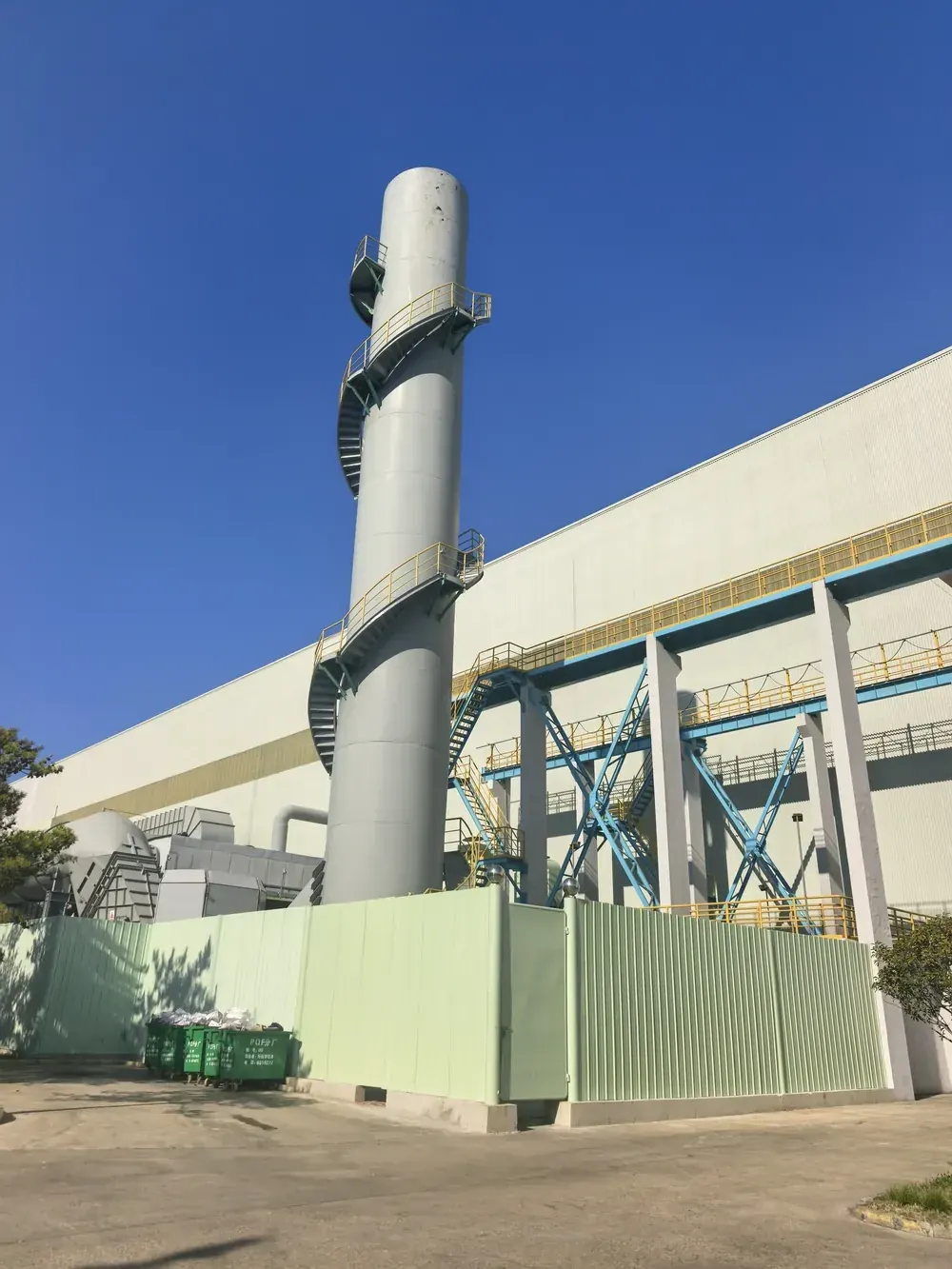
Height 8–245 m · Shell Ø 0.5–4.5 m · Plate 6–40 mm. Single-flue, guyed, multi-flue and framed chimneys for power plants, biomass plants and process industry — designed to GB/T 50051-2021 and GB 50135-2019, fabricated and welded to AWS D1.1.
An industrial steel chimney is a pressure vessel for hot gas that happens to stand in the air. It is designed for wind, earthquake, thermal expansion and — most of all — the chemistry of what comes out of the stack. Get the chemistry wrong and the best-welded shell in the world will be scrap in seven years.
One Product, Four Decisions
Every chimney quotation comes down to four choices. Get them right at the enquiry stage and the project runs itself; get them wrong and every later step inherits the problem.
Structural Type
Self-supporting, guyed, braced tower or multi-flue. Decided by height, plot size, soil and the chimney's interface with the plant.
Compare the four types → 02 · CorrosionMaterial & Lining
The flue gas decides the lining. Coal, gas and biomass need three different answers — and the wrong one is a ten-year stack, not a thirty-year one.
Select by fuel → 03 · FabricationManufacturing
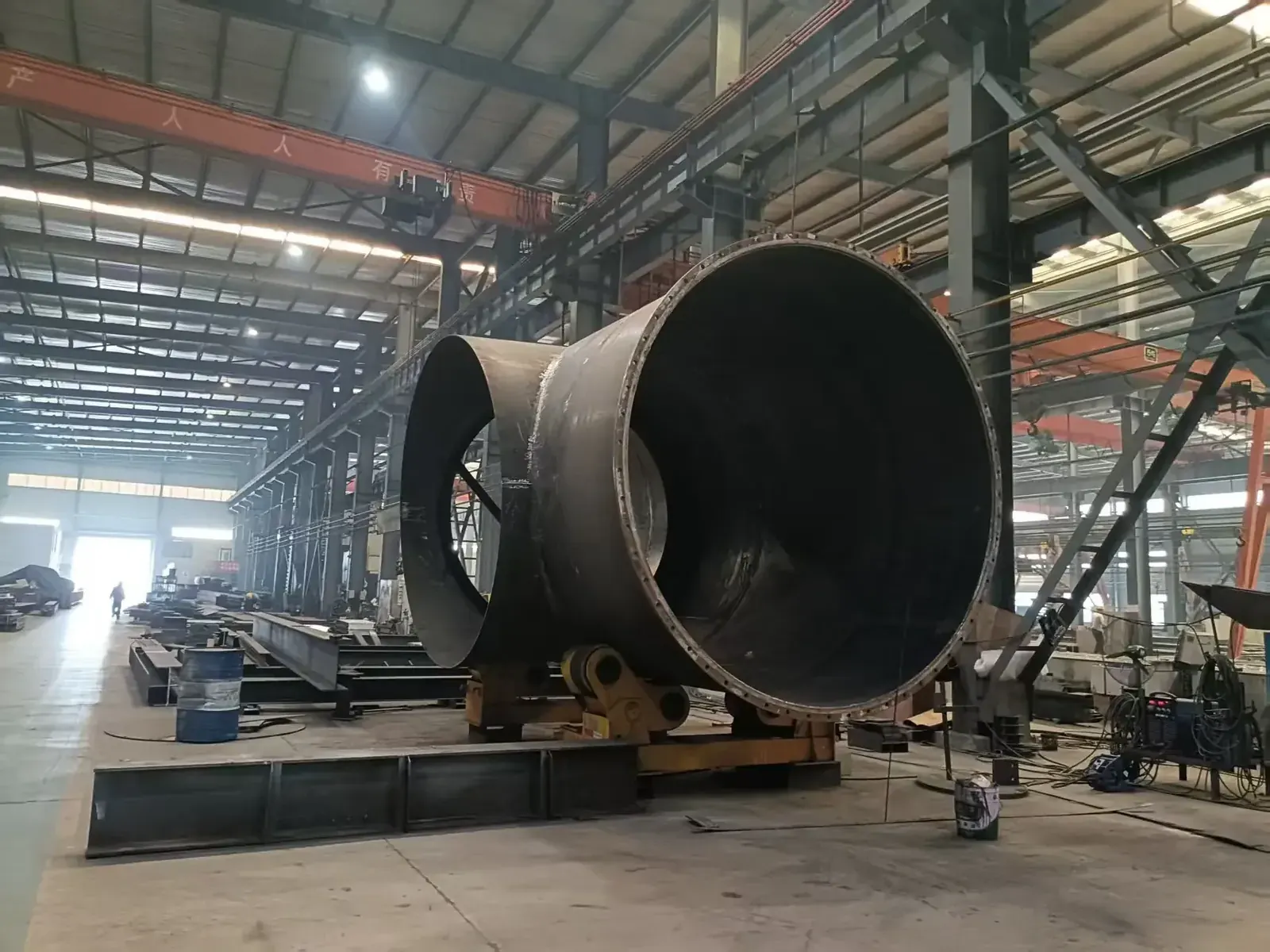
Rolling, welding, NDT, blasting, lining, coating, trial assembly. Twelve controlled stages, each with a hold point you can inspect.
See the process → 04 · DeliverySegmentation & Shipping
How a 90 m stack becomes truck-sized pieces, and how those pieces arrive at your site without a bent coating.
Request a quote →What the calculation actually covers
A chimney is not a pipe standing up. The design has to answer four separate questions, and a quotation that cannot answer all four is a guess.
- Wind — static and vortex-shedding response at the site's design wind speed, including the effect of attached platforms and ladder
- Seismic — base shear and second-order effects at the site's seismic category
- Thermal — differential expansion between the flue and the shell, and the resulting nozzle loads on the plant duct
- Corrosion allowance — sacrificial thickness where a lining is not used, calculated over the design life
We design to GB/T 50051-2021 (chimney engineering) and GB 50135-2019 (high-rising structures) as standard, with EN 13084-1/-2 available where the client specifies European code. The calculation report is part of the delivery documents.
What Ships in the Contract
| Included as standard | Optional / project specific |
|---|---|
| Structural calculation report to GB/T 50051-2021 | Third-party design review |
| Shell, base plate and anchor bolt template | Anchor bolts and nuts |
| Internal lining per the specified system | Corrosion-resistant brick lining |
| External coating to ISO 12944 C4 or C5-M | Special colours, aviation warning scheme |
| Access ladder, safety cage, rest platforms | Aviation obstruction lights and wiring |
| Sampling and inspection ports | Continuous emission monitoring (CEMS) ports |
| Flue gas inlet flange, matched to your duct | Expansion joint and duct spool |
| Trial assembly and shipping marks | Site erection supervision |
Where a steel chimney is the wrong answer
We would rather lose the order at the enquiry stage than sell a type that does not fit. These are the cases where we tell clients not to use a steel chimney, or to use a different form of it.
- Wet FGD with no reheating — at 45–55 °C saturated gas, a bare carbon steel shell will not survive. It needs a duplex liner or acid-resistant brick, and that decision doubles the lining cost. Say it early.
- Very high chloride with high temperature — waste incineration flue gas above 200 °C with heavy chlorides sits in the worst possible window for stainless. Often the answer is brick, not metal.
- Tight plot, very tall stack — above roughly 100 m on a small footprint, a concrete shell with an internal flue is often cheaper than a self-supporting steel shell.
- Severe vibration environment — very slender stacks in high-wind, low-turbulence sites need vortex-breaking devices; we will say so rather than build a stack that hums at night.
Questions We Get First
How tall should the chimney be?
Height is set by dispersion requirements in your environmental permit, not by us. We build to the height your permit or your engineer specifies, and we can check it against GB/T 50051 dispersion guidance if you have no figure yet.
Self-supporting or on a tower?
Up to about 60 m, self-supporting is normally cheapest. Between 60 and 90 m it depends on the plot and soil. Above 90 m a tower or a concrete shell often wins. See the types comparison.
What steel grade do you use?
Q355D as standard for the shell, Q235B for secondary steel, 304/316L or 2205 duplex for liners and wet zones. Grade is confirmed against the flue gas condition, not against price.
Can you match an existing chimney's dimensions?
Yes — send the existing drawings or a measured survey. Replacement stacks that fit existing foundations and duct connections are a routine job for us.
Continue reading
Send Your Chimney Spec —
Response Within 24 Hours
Our engineers review every enquiry personally. Attach a drawing or just describe the plant — we will come back with a technical proposal and a priced offer.
- Drawings or applicable standard
- Quantity / number of stacks
- Destination port
- Flue gas condition
- Required delivery date
- Payment terms